

HeyGen Alternatives: Best AI Avatar Tools in 2026
HeyGen vs Synthesia, D-ID, Colossyan, Hour One, Tavus, and Versely. Honest picks for avatar video, lipsync, voice cloning, and multilingual content.
HeyGen ate the AI avatar market in 2024 by being the first tool that made talking-head avatars look almost human. Two years later, that lead has eroded. Synthesia closed the realism gap, Tavus made personalized clones a real product, D-ID rebuilt around streaming, and a wave of cheaper specialty players are picking off the workloads HeyGen used to monopolize. The result: HeyGen is still good, but it is no longer the obvious default for any single use case.
This is the comparison I wish existed when I last audited my own avatar stack. Not "which avatar tool is best," because no single tool wins everything, but "which tool wins which job, at what price, and how do you avoid stacking five subscriptions." Versely's multi-model bundle is the honest answer to the last part, and I'll explain why after the standalone trade-offs.
What HeyGen still does well
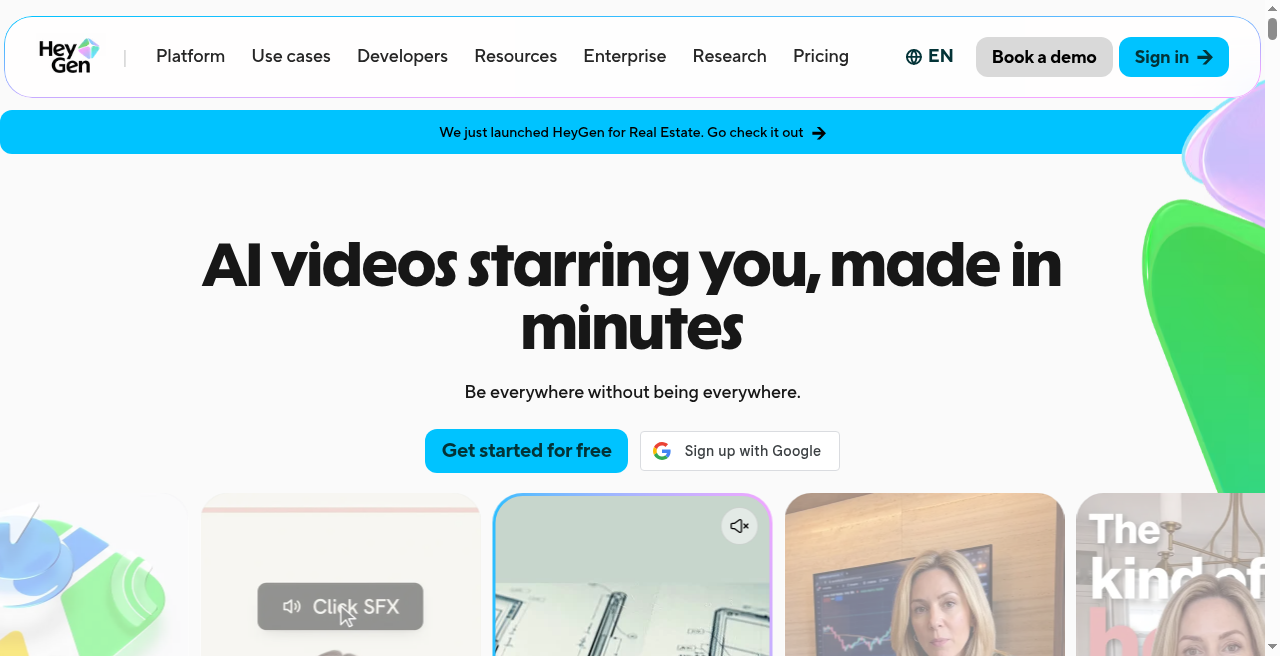
HeyGen's Avatar V3 is genuinely good at what HeyGen has always been good at: a templated talking-head that reads from a script, lips synced cleanly, in 175+ languages, with brand-consistent backgrounds and lower thirds. The instant-avatar feature (record two minutes of webcam, get a usable clone within an hour) is still the fastest onboarding in the category.
For corporate training videos, internal comms, and sales-outreach personalization at moderate volume, HeyGen's editor is hard to beat on pure UX. The asset library, the brand kits, the team-collaboration workflow, and the SCORM export for LMS use are mature in a way most competitors are not. Studios that produce avatar content as a side workflow (not their core product) tend to stay on HeyGen because switching costs more than it saves.
The browser-based interface also matters more than people credit. HeyGen runs on a Chromebook. Synthesia mostly does too. D-ID's heavier streaming features benefit from a desktop. For distributed marketing teams where half the staff are on travel laptops, the lightweight web app is a feature.
Where HeyGen falls short in 2026
Three structural problems have caught up with HeyGen this year.
Lipsync drift on long-form scripts. HeyGen's Avatar V3 lipsync is excellent for clips under 60 seconds. Past 90 seconds, mouth shapes desync subtly, eye contact breaks, and the avatar starts looking "off" in ways that audiences notice without being able to articulate. Synthesia and Tavus both hold sync better past the two-minute mark.
Pricing creep on the Creator and Team tiers. The Creator plan jumped to 39 dollars a month in early 2026, the Team plan to 89, and the per-minute overage rates climbed with them. The Pro tier added gating around the highest-fidelity avatars and 4K export. For solo creators producing more than 30 minutes a month, the math now favors lighter alternatives or a multi-model bundle.
Avatar variety plateau. The stock avatar library has not meaningfully expanded in the past year, and the custom-avatar pipeline still requires upload-and-wait. Competitors like Colossyan have rolled out conversation-mode avatars (two avatars in dialogue) and Tavus has shipped real-time interactive avatars. HeyGen's roadmap looks conservative by comparison.
The contenders, honestly assessed
Versely (multi-model bundle)
Versely is not a single avatar engine. It is a routing layer that gives you HeyGen-class avatars, Synthesia-class realism, D-ID streaming, and the underlying lipsync and voice-clone primitives in one subscription. The pitch: pick the best avatar model per shot instead of paying for one vendor's worst output.
Best for: creators and small teams who produce avatar content alongside other formats (short-form video, b-roll, music, thumbnails). The bundle starts to pay off the moment you need more than one tool.
Strengths: access to multiple avatar engines through a unified UI, plus AI Lipsync and AI Voice Cloning as standalone primitives you can apply to any video, not just avatar templates. The AI Video Generator routes to VEO 3.1, Sora 2, and Kling 2.5 for non-avatar shots.
Pricing: 29 dollars a month for the Creator tier covering avatars, video, image, voice, and music. 79 dollars for Team. Per-minute output costs are unbundled and visible.
Weaknesses: if your only workflow is "avatar video, nothing else," a single specialized tool may have a deeper editor for that one job. Versely is breadth-first.
Synthesia
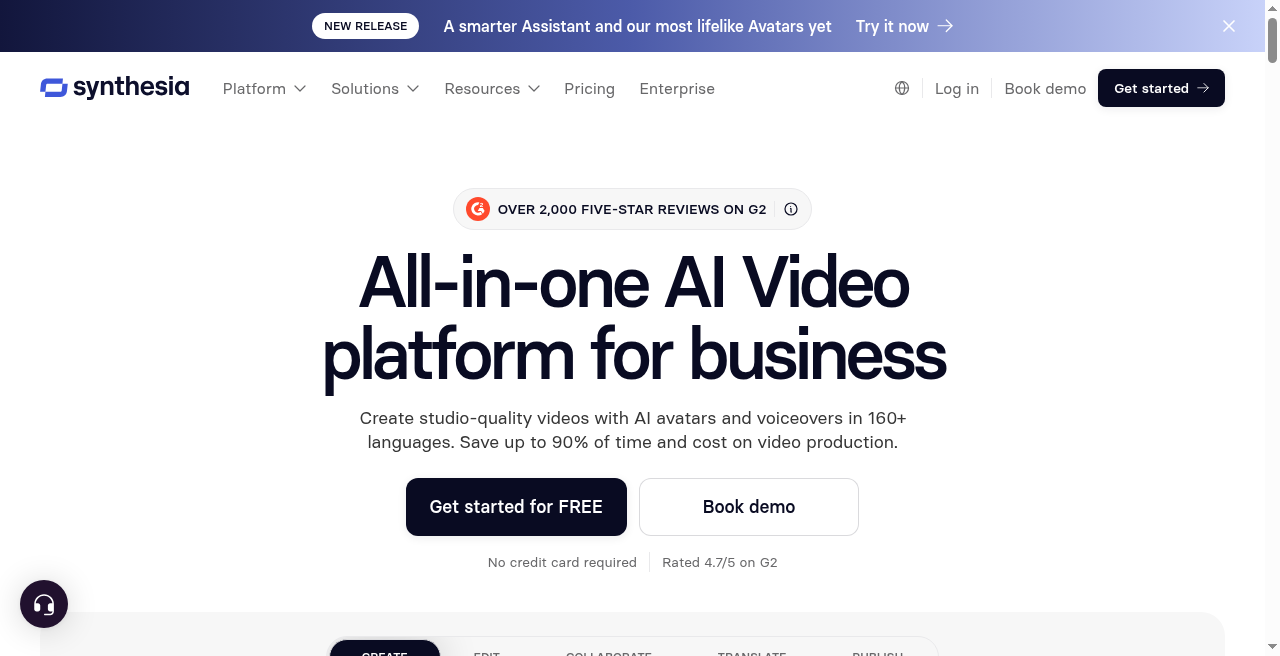
Synthesia is the enterprise gold standard. The Express-2 avatars launched in late 2025 set a new realism bar, particularly around micro-expressions and idle motion. The platform integrates with corporate SSO, supports SCORM 2004 export, and ships with the kind of compliance and audit logging that procurement teams care about.
Best for: large enterprises producing training, onboarding, and compliance videos at scale. Procurement-heavy buyers who need DPAs and SOC 2 reports.
Strengths: highest realism among avatar-only platforms, mature enterprise features, 140+ languages, and a custom-avatar pipeline that has shipped at Fortune 500 scale for two years.
Pricing: Starter at 29 dollars a month for limited minutes, Creator at 89, Enterprise priced per seat with annual contracts that typically start around 12,000 dollars a year for a small team.
Weaknesses: slow generation times under load, an editor that feels heavier than HeyGen's, and Enterprise pricing that pushes solo creators and small teams elsewhere.
D-ID
D-ID rebuilt their product around real-time streaming avatars in 2025, and the bet is paying off. Their Agents API lets you build interactive avatar experiences (customer-service bots, virtual receptionists, live event hosts) that respond in under 800 milliseconds.
Best for: product teams building avatar-driven interfaces, conversational agents, and live experiences.
Strengths: the lowest-latency streaming avatars in the market, an excellent API surface, and integration with most major LLM providers for the response generation layer.
Pricing: API-first pricing starts at 0.10 dollars per generated minute on the entry tier, with Enterprise streaming contracts negotiated separately. Their consumer-facing Creator Studio runs 5.99 to 49 dollars a month.
Weaknesses: the offline batch-render pipeline is weaker than Synthesia's. Avatar realism is a notch below HeyGen Avatar V3 for static talking-head video. D-ID is best as an API, not a marketing-team editor.
Colossyan
Colossyan owns the conversation-mode niche. Two avatars in dialogue, hand-off between speakers, and a built-in scenario editor for branching training content. For learning and development teams producing scenario-based training, Colossyan is genuinely the best tool.
Best for: L&D teams, soft-skills training producers, customer-service training scenarios.
Strengths: the best multi-avatar dialogue UX in the category, branching scenario logic, and an avatar library with deliberately diverse representation across age, ethnicity, and accent.
Pricing: Starter at 27 dollars a month, Pro at 87, Enterprise custom. The mid-tier pricing is competitive with HeyGen.
Weaknesses: smaller language coverage than Synthesia or HeyGen (around 70 languages vs 140+). The single-avatar workflow is fine but not class-leading.
Hour One
Hour One went deep on the templates-and-data-binding angle. You build a template once, bind it to a CSV or a database, and generate hundreds of personalized avatar videos from a single setup. For sales-outreach and personalized-ed-tech use cases, this is the right architecture.
Best for: high-volume personalization workflows. Sales teams sending personalized prospect videos. Ed-tech platforms generating per-student feedback videos.
Strengths: the best data-binding and bulk-generation pipeline. Strong API. Good Salesforce and HubSpot integrations.
Pricing: Lite at 25 dollars a month for limited minutes, Business at 100, Enterprise custom. Bulk-generation pricing scales reasonably.
Weaknesses: avatar realism is mid-pack, the editor is functional rather than elegant, and the platform is overkill if you're not doing high-volume personalization.
Tavus
Tavus is the personalized-clone specialist. Train an avatar on a few minutes of footage of your founder or a sales rep, then generate thousands of personalized variants where each viewer hears their own name, company, and context spoken naturally.
Best for: B2B sales, account-based marketing, founder-led personalized outreach.
Strengths: the best clone fidelity for short personalized clips. Conversational Video Interface (CVI) launched in 2025 lets the clone respond live in conversation. API-first.
Pricing: developer plan at 39 dollars a month, Startup at 199, Enterprise custom. Per-minute generation costs are line-itemed.
Weaknesses: the editor is rudimentary because the product is API-first. Long-form avatar video is not the focus. If you want a corporate-training-video platform, this is not it.
The honest comparison table
| Tool | Avatar realism | Lipsync stability | Multilingual | Real-time | Bulk generation | Price tier | Best for |
|---|---|---|---|---|---|---|---|
| Versely | High (multi-model) | Highest (dedicated lipsync engine) | Yes (175+) | Via D-ID routing | Yes | $ | Multi-format creators, small teams |
| HeyGen | High | Mid-high | Yes (175+) | Limited | Yes | $$ | Mid-volume corporate, sales personalization |
| Synthesia | Highest | High | Yes (140+) | No | Limited | $$$ | Enterprise training, compliance |
| D-ID | Mid-high | Mid | Yes | Yes (best in class) | Via API | $ | Conversational agents, live experiences |
| Colossyan | Mid-high | High | Yes (70+) | No | Yes | $$ | L&D, scenario-based training |
| Hour One | Mid | Mid-high | Yes | No | Yes (best in class) | $$ | High-volume personalization |
| Tavus | High (clones) | High | Yes | Yes (CVI) | Via API | $$ | B2B personalized outreach |
Read the table once and stop looking for the single best avatar tool. There is no answer to that question, only answers to "which is best for this workflow."
Migrating off HeyGen, or combining with it
You do not have to leave HeyGen to fix what is broken about your current setup. The smarter move for most teams is to keep HeyGen for what it does well and route the failing workloads elsewhere.
If your problem is lipsync drift on long-form videos, the cheapest fix is to record voiceover separately and run the avatar render through a dedicated lipsync engine like the one at AI Lipsync. You keep HeyGen as the avatar source and clean up the sync downstream.
If your problem is per-minute pricing creep, audit which workloads actually need HeyGen-grade avatars and which could be served by D-ID or Colossyan at a lower per-minute rate. Most teams overspend on avatars by a factor of 2-3 because they default to the most expensive option for every use case.
If your problem is needing other formats (b-roll, product video, music, thumbnails), consolidating onto a multi-model platform is almost always cheaper than stacking subscriptions. Versely was built for exactly this scenario: avatars from the right engine, video from VEO 3.1 or Kling 2.5, voice from a cloned model, music from Suno V5, thumbnails from Imagen 4, all in one bill. See AI Video Generator for the routing layer and the best AI avatar generators 2026 post for a deeper avatar-only comparison.
If your problem is building a product that needs avatars (a chatbot UI, a learning platform, a sales tool), use D-ID or Tavus APIs directly. The editor-first tools are the wrong shape for that workload.
FAQ
Is HeyGen still worth it in 2026?
For mid-volume corporate work and sales personalization, yes. As your default for every avatar workload, no. Synthesia beats it on enterprise realism, D-ID beats it on real-time, and a multi-model bundle beats it on cost-per-minute once you cross 30 minutes of monthly output.
What is the best free HeyGen alternative?
D-ID's free tier is the most generous for short clips. HeyGen's own free tier exists but is heavily watermarked. For a true production-quality free path, none of the editor-first tools deliver. Self-hosted lipsync models exist but require a 24GB+ GPU.
Can I use HeyGen for commercial work?
Yes, on the Creator tier and above. Read the terms carefully around stock avatars (most are licensed for commercial use, but a few have restrictions) and around custom avatars (you must own the likeness rights, which matters for sales personalization workflows where you clone a real rep).
How does avatar lipsync quality compare across tools?
For clips under 60 seconds, HeyGen, Synthesia, and Versely's lipsync engine are roughly tied. Past 90 seconds, Synthesia and dedicated lipsync engines hold sync visibly better than HeyGen. Past three minutes, the gap is unmissable. If your scripts are long, do not rely on a single-pass avatar render.
Should I subscribe to multiple avatar tools?
Almost never. The typical solo creator covers 95 percent of needs with one of HeyGen, Synthesia, or a multi-model bundle. Stacking subscriptions only makes sense if you have one workload that requires Tavus-style clones and another that requires Synthesia-grade realism, which is a small minority of teams.
Closing
The HeyGen-vs-everyone-else conversation in 2026 is no longer one-sided. HeyGen lost the must-have status it had two years ago, and the field is now plural: Synthesia for enterprise realism, D-ID for real-time, Colossyan for scenarios, Hour One for personalization, Tavus for clones. Versely's AI Video Generator bundles the underlying primitives so you stop paying multiple vendors for overlapping features.
Pick one talking-head script from your current project, render it in HeyGen and one alternative side by side, and decide for yourself. That A/B test will teach you more in an hour than any comparison article. For broader workflow context see the Runway alternatives 2026 post and the best AI video generation models 2026 deep dive.