

Captions.ai Max is not karaoke
Max is $24.99 for 500 credits of Mirage actors, twins, and prompt-to-video. Karaoke burn-in is caption styles, not a $25 generative seat.
Captions.ai Max is not karaoke. Max is $24.99 a month for 500 credits of Mirage actors, twins, and prompt-to-video. Karaoke burn-in is caption styles on speech you already have. Do not buy a $25 generative seat to typeset words.
That split is a product boundary, not a dunk. The company is named Captions. The public pricing page (fetched 19 September 2026) still marks Max as most popular and sells it with the line "Use generative AI to make new footage, AI actors and more." Karaoke is not that line. If the file already exists and someone spoke, you need burned-in captions, not a twin.
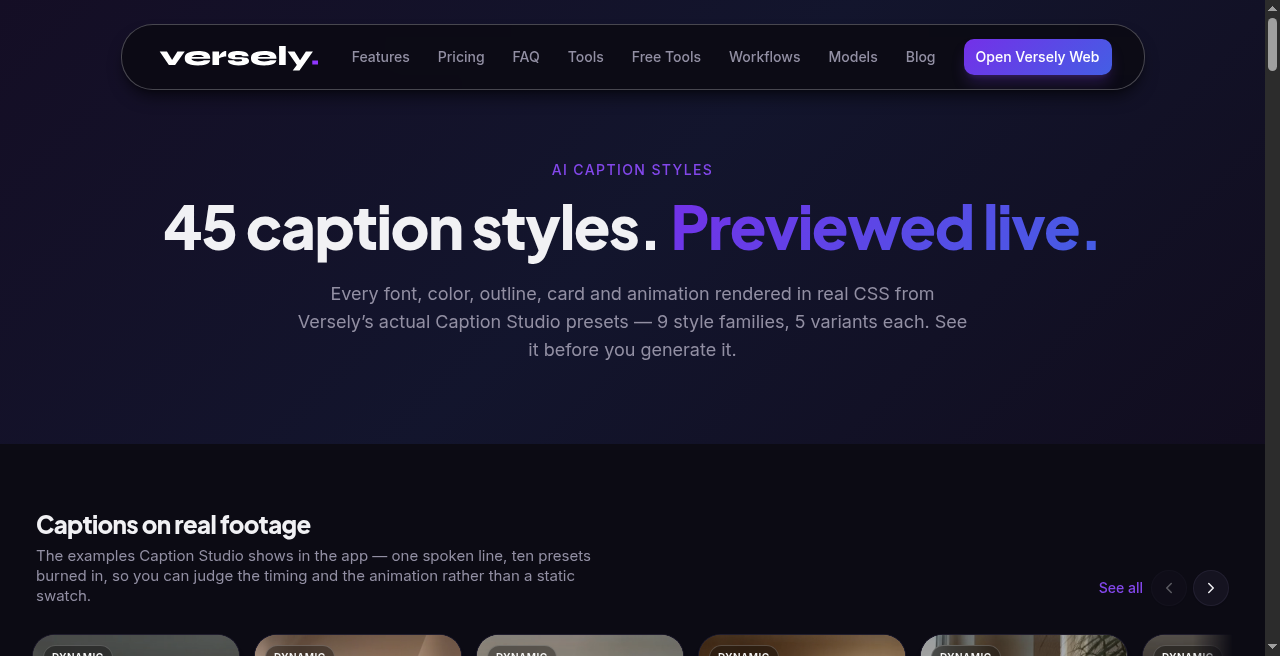 Versely caption styles. Forty-five CSS presets. Snap and Reveal are the timed karaoke families. This is typesetting, not a Mirage seat.
What Max actually sells
I re-read Captions subscriptions and Captions AI usage on 19 September 2026. The help ladder is still:
| Plan | Price on help (USD / mo) | Credits | What the Max-shaped row is for |
|---|---|---|---|
| Free | $0 | 60 to 200, lifetime, do not refresh | Captions, trim, camera, one template (Eclipse) |
| Lite | $4.99, Android only | Not a Max row | Manual edit and caption styles on Android |
| Basic (formerly Pro) | $9.99 | 200 / mo | Caption and dub, script, camera, eye contact, denoise |
| Max | $24.99 | 500 / mo | Mirage actors, 30 AI Twins, Chat to Edit, AI Edit, Clips, concurrent gen (2) |
| Scale | $69.99 | 1,400 / mo | Everything in Max, larger pool |
The public pricing page is narrower. It cards Free, Max, Scale, and Enterprise. The footnote says prices and features on that page reflect iOS plans only. Max is $24.99/mo and 500 credits. Scale is $69.99/mo and 1,400. I did not see a yearly dollar amount on either page, so I am not inventing one. Yearly exists as a discount toggle in the FAQ. The monthly card is the number you can quote.
Max is the generate row. Help lists, on Max: everything in Free and Basic, then Chat to Edit, AI Edit, Clips, Mirage-generated actors, up to 30 AI Twins, concurrent video generation (up to 2), and model pickers for generated media, sound effects, and music. The gen-AI video table on the same subscriptions page gates Ray 2, Veo 3, Pika 2.2, Kling, and MiniMax Video-01 to Max and Scale. That is a model locker, not a caption locker.
Prompt-to-video is the talking-head factory. Captions Prompt to Video is powered by Mirage. A-roll is a generated actor. B-roll is generated around it. The usage table still prices that job at 16 credits every 6 seconds. On a 500-credit Max pool, that is 31 full 6-second units if you spend nothing else (500 / 16 = 31.25, so 31 runs and 4 credits left). About 186 seconds of Mirage talking video. AI Edit is listed at 10 to 40 credits. You cannot buy extra credits a la carte. Unused paid credits can roll into a cap of three times the monthly allowance. Credits still deduct if you never export.
That meter is why Max costs $24.99. You are buying a generate pool and a twin roster. You are not buying karaoke.
A twin is a clone of a real person you record. Help's AI Twin FAQ still says you can generate up to 30. Max is the plan that names that cap. A Mirage actor is a person who does not exist. Prompt-to-video is the button that makes that person talk. None of those objects transcribe a take you already shot. None of them are a caption preset.
If you actually need that factory, Max is a coherent seat. If you needed words on a founder clip, you opened the wrong card because it was marked most popular.
Karaoke is burn-in, not a generate
Karaoke is a finish step. The take is already in the timeline. Someone already spoke. You transcribe, you pick a family, you burn type into the MP4 so mute autoplay still carries the hook. No new actor. No new footage. No 16-credit Mirage clock.
On Versely that finish step is caption styles: 45 CSS presets, 9 groups, 5 variants each. Classic, Paper, Ink, Halo, Hype, Signature, and Headline are subtitle families. The line arrives as a block. Only two groups are word-timed karaoke:
- Snap caption group:
kind=timed,effect=pop, Anton, bottom. Base presetword_pop, labelled Snap, accent#FF4785. Gold, cyan, lime, and mono change the accent. They do not become a twin. - Reveal caption group:
kind=timed,effect=typewriter, TikTok Sans, bottom. Base presettypewriter, labelled Reveal, gold accent. Words appear one at a time and stay.
That shelf is CSS. It is not prompt-to-video. It does not consume a Max twin slot. It does not run Mirage. A founder take plus a Snap burn is typesetting. A prompt plus "make an actor say this" is generation. Mixing them is how a karaoke brief pays $24.99 for 500 credits of a model locker.
The labor path is the AI caption generator: transcribe, correct names and numbers, apply the family, preview, burn. Add captions to a video is the same family of work (165 language codes, 21 BASIC looks at 1×, 9 DYNAMIC at 2×). Picture lock first. Voice lock second. Then karaoke. A pop attached to audio you are about to recut is a clock you will throw away.
 Speech in, styled type out. The generator burns a family onto a file you kept. It does not hire a Mirage actor.
Captions.ai can karaoke too. That is the other half of the trap, and it is worth saying out loud. Help's Free plan includes Captions, with one template named Eclipse. The iOS pricing compare table lists captions in 100+ languages on Free, customizable captions on Free, and caption templates as 1 on Free versus 100+ on Max. Karaoke is not gated on Max. A larger template shelf is. If the upgrade prompt is "unlock templates," you are being sold a generate seat with a template column attached.
The web add-captions flow makes that worse. Add captions on web currently sends you through AI Edit styles first. Those are premium styles and use more credits than a captions-only pass. Captions only is a side tab. Switching a captions-only style is listed at about 3 credits. AI Edit styles are estimated around 15, depending on the look. That is how a karaoke seeker gets billed like an AI Edit customer. The product can caption without Max. The popular path is built to look like Max.
Do not prompt Max to "make it karaoke." Prompt-to-video will bake letters into generated frames. You cannot restyle those glyphs next week. Karaoke is a second pass on a file you kept. Open the group hub for the live CSS. A screenshot of a Mirage actor with punchy type is still a generate, not a preset.
Silence is a different skip. No speech, no word clock. A pack shot with a bed has nothing for Snap to pop or Reveal to type. Author a hook overlay if you wrote a line nobody said. Do not spend Max credits to invent a speaker just so karaoke has a clock, and do not run a timed family on a mute plate.
The product is named Captions. That is the trap.
Search "captions app" and you land on a company whose paid hero is generative video. The logo still says Captions. Max is still marked most popular. The compare table still puts "Caption templates 100+" in the Max column, next to AI Twin, AI Creator, AI Edit, Clips, and the chat editor. A tired producer reads "captions" and "most popular" and clicks $24.99.
That click buys the factory. The template count is a side effect.
A caption template is a typesetting preset: font, color, active-word color, split, transition. Captions.ai documents that shelf in Captions.ai caption style help: text color, emphasis, active word, stroke, split words, fonts, transitions, saved templates. Web claims "over 30 preset templates" in that help article and "100+" on the iOS pricing table. I am not reconciling those two marketing numbers. Neither number is a Mirage actor. Neither number is 30 twins. Neither number is 16 credits per 6 seconds.
Versely's shelf is the 45-preset caption styles index. Nine families. Five variants. Snap and Reveal for karaoke. Classic when you only need a readable block. Headline when the job is a Bebas title row, not a transcript. You pick a family and stop. You do not pay a generative monthly because the aisle got longer.
The name collision is the same pattern as every vendor surface that outgrew its first noun. Flow is a Veo launcher that says filmmaking. Captions.ai is a generate studio that says captions. Each one is correct as a launcher for what it actually meters and expensive as a home for the job on the tin. If your week is founder takes that need Snap or Reveal, Max is the expensive way to buy a typesetter. If your week is "I need a person who does not exist to read this script," Max is at least the right aisle.
Android Lite is a different door, not a Max substitute you should upgrade past. Help prices Lite at $4.99 a month, Android only, and lists change-caption-styles as a Lite feature on that OS. Restore Lite on Android. A separate Basic, Max, or Scale subscription is required for those features on desktop and iPhone. That sentence is why an Android caption job is not a $24.99 iOS Max card. Do not "fix" an Android style lock by buying Max on another device unless you also wanted twins.
Basic at $9.99 and 200 credits is still not karaoke-as-a-service. It is the former Pro plan: caption and dub, script, camera, a set of AI edit tools. If all you needed was burn-in on a talking-head file, even Basic is a larger seat than the job. Free already includes Captions and Eclipse. Max is two steps past that, sold as footage you do not have.
Watch the credit rules if you already hold Max for the wrong reason. Help: credits renew monthly on Basic, Max, and Scale. Free is a one-time allotment. You cannot buy individual credits. Generation spends credits even when you do not export. Downgrade clips the balance to the new cap and forfeits the rest. Cancellation forfeits remaining credits at period end. Those are generate-pool rules. They are a poor match for "I wanted Anton on this take."
The test for skipping the seat
Ask three questions. Did anyone speak on a file you are keeping? Do you need a person who does not exist? Do you need a digital twin of someone who does?
If someone spoke and you want each word to punch, you want karaoke. Open caption styles. Run the AI caption generator on the file you are keeping. Burn Snap or Reveal after crop. Do not open Max.
If you need a person who does not exist to deliver a 30-second (or 1,000-character) prompt, you want prompt-to-video. That is Mirage. That is Max's aisle. Stay there, and know the meter: 16 credits per 6 seconds against 500.
If you need a clone of a real face you will record, you want an AI Twin. Max names 30. That is still not karaoke. Caption the twin output later if it has speech. The twin is the generate. The caption is the burn.
If nobody spoke, skip karaoke. If you do not need a generated actor, skip Max.
Four briefs that fail the test:
- "Get Captions Max so the words pop." Incomplete. Pop is a caption effect. Max is a generate seat. Ask which file already exists.
- "We need karaoke like TikTok, so Max." TikTok karaoke is timed type on speech. Versely Snap is that family. Max is Mirage, twins, and AI Edit.
- "Unlock caption templates, buy Max." The iOS table does put 100+ templates on Max. It also puts captions on Free. A template upgrade is not a $24.99 generate pool. If the shelf you wanted is 45 previewable families, that URL is caption styles.
- "The web editor asked for an AI Edit style." That is the web add-captions default, not proof you needed Max. Open Captions only, or leave and burn on the file you kept.
Name the object in the brief. Put the URL in the cell. Tag the export word_pop or typewriter when the job is karaoke, mirage or twin when it is not. An editor who inherits "just use Captions" from Slack should know whether they are burning type or generating a person. If they cannot tell, the brief named a company, not a tool.
Do not cancel Captions.ai because the logo feels dated. Drop Max when the slate was never Mirage. If the slate is Mirage actors and twins, keep the seat. The only decision is whether this week's files already exist.
When the brief is karaoke and you need the app, join Versely and open caption styles. Keep the generate seat for weeks that actually generate. Stop treating a $24.99 Max card as a karaoke license.
FAQ
Does Captions.ai Max include captions?
Yes. Captions, including 100+ languages on the iOS compare table, already sit on Free. Max adds the generate stack: Mirage actors, up to 30 AI Twins, AI Edit, Clips, Chat to Edit, concurrent generation, and a 500-credit pool. Karaoke is not the reason the card is $24.99.
Should I buy Max if I only need karaoke burn-in?
No. Karaoke is typesetting on speech you already have. On Versely that is caption styles (45 presets; Snap and Reveal are the timed families) and the AI caption generator. On Captions.ai, Free already includes Captions with one template. Max is the Mirage and twin seat.
When is Max the right bill?
When the job is a generated actor, a twin, prompt-to-video at 16 credits per 6 seconds, AI Edit, Clips, or the Max-gated model locker. Then $24.99 and 500 credits is a generate pool, not a caption license. Recheck subscriptions and AI usage the day you quote a client. These numbers are from 19 September 2026.