

Bria Fibo 2.0 release: price, license, editing
Bria released Fibo 2.0 on 18-19 October 2026: one 8B open-weights model that makes and edits images, trained on licensed data. 4 credits on Versely.
Bria released Fibo 2.0 on 18 and 19 October 2026. It is an 8B-parameter open-weights model that generates and edits images with one set of weights, trained only on licensed data. Bria ranks it first for image editing among open-weights models. On Versely it costs 4 credits an image, to generate or to edit.
Key facts
| Item | Detail |
|---|---|
| Released | 18-19 October 2026, on Hugging Face |
| Size | 8B parameters, about 1 megapixel |
| Checkpoints | Dev (generate and edit), Edit Turbo (4-step edits) |
| Edits | Instruction, masked, up to 4 images |
| Weights license | CC BY-NC 4.0 (non-commercial) |
| API list price (fal) | $0.04 per image |
| Versely | 4 credits, generate or edit |
The release dates are the days Bria uploaded the two checkpoints to Hugging Face, as ComfyUI Wiki's 20 October report records. The ranking is Bria's own claim on its model card, against open-weights models on the Artificial Analysis image arenas as of 20 October 2026, not against closed models. Sources, all read on 30 October 2026: Bria's Fibo 2.0 Dev and Fibo 2.0 Edit Turbo model cards, and fal's Fibo 2.0 Generate and Edit API pages.
What Fibo 2.0 is
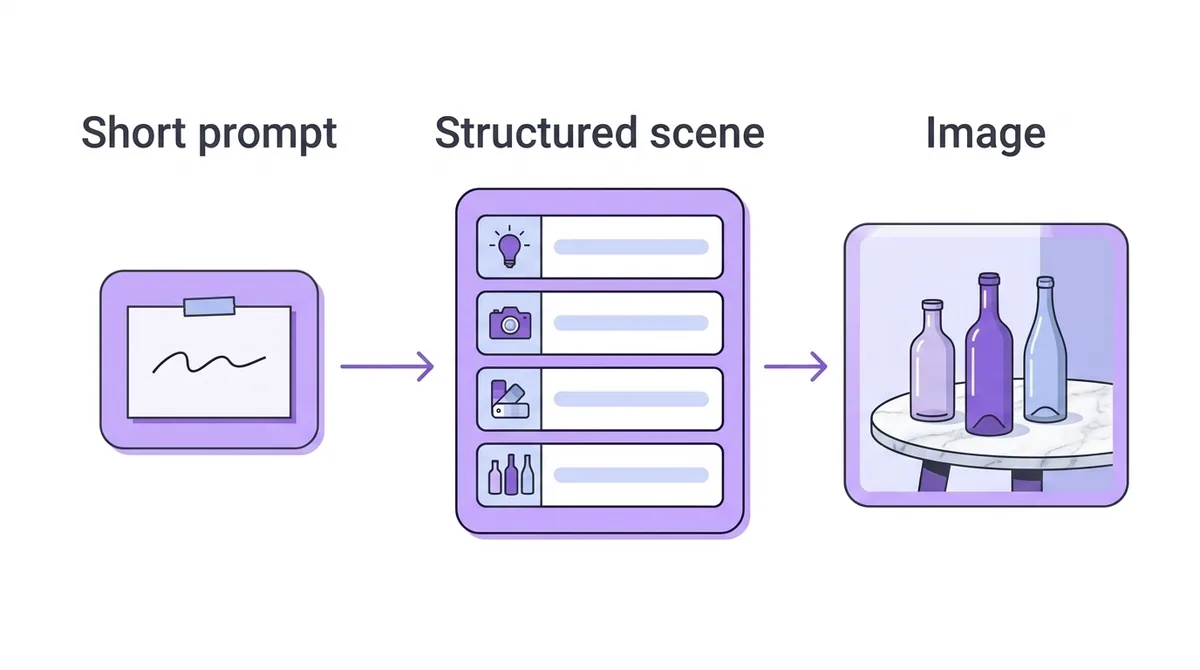
Bria's pitch is that most image models excel at imagination but not at control. Its FIBO family was trained on long structured captions, up to 1,000+ words, that describe lighting, composition, colour, camera and depth of field as separate fields. Bria calls this format VGL, the Visual GenAI Language: a JSON document in which every object in the scene, the light and the camera are addressable on their own.
You don't write that JSON by hand. A short prompt is expanded into a full VGL description first, and the model renders that. Bria's open-source bria-vgl package does the expansion, and fal's endpoints return the VGL alongside the image, so a developer can change one field and render again. Bria's point is control: change the camera angle or the time of day and the rest of the scene shouldn't drift.
Bria's own prompt-alignment example shows what that is for: "a row of exactly five red apples and one green pear, the pear in the second position from the left", with a brass bell on the third apple from the right. Counts, positions and attributes are where Bria says the structured captions pay off.
What is new compared with earlier FIBO models
Fibo 2.0 is the first FIBO release in which generation and editing live in one model. Before it, Bria shipped text-to-image FIBO and separate editing checkpoints (FIBO-Edit 1.5 came out in August 2026). Per Bria's model card, the new version adds:
- General editing. Instruction edits that change what you ask for and keep identity, layout, lighting and fine detail elsewhere.
- Masked edits. Paint the region to regenerate; the rest keeps its original pixels.
- Multi-reference edits. Up to 4 images in one request, referred to as
<image_1>,<image_2>and so on. Bria names virtual try-on, product integration and style transfer as the uses. - Better text, texture and anatomy. Bria reports gains in legible typography, surface texture and hands, faces and poses over earlier FIBO releases.
- Style modes. Five optional photographic looks for text-to-image: Boring Reality, Kodak Film, Hard Flash, Hazy / Dreamy and Lens Distortion.
The two checkpoints split the work. Dev is the full, non-distilled model: 50 steps with classifier-free guidance, for generation, editing and fine-tuning. Edit Turbo is distilled for editing only and runs in 4 steps with no guidance, for lower latency and cost. ComfyUI Wiki lists the repository at a 16.25 GB transformer, an 8.88 GB text encoder and a 0.34 GB VAE.
Bria lists more on its roadmap as "coming soon": multi-turn editing that keeps the rest of the image pixel-stable, background removal, a product-shot LoRA, an eraser by mask and image expansion. None of those has shipped yet.
The license: weights versus the hosted API
This is the part to read twice. The open weights on Hugging Face are released under CC BY-NC 4.0, for non-commercial use. Bria's card says commercial use of the weights needs a separate commercial agreement with Bria. A team downloading Fibo 2.0 to run on its own GPUs for client work needs that agreement.
The hosted API is a different route. fal lists bria/fibo-2/generate and bria/fibo-2/edit for commercial use and describes the model as "trained only on licensed data, with clear commercial rights". Versely runs Fibo 2.0 through those fal endpoints. Bria's wider pitch is the training data: 100% licensed, with what it calls attribution traceability and legal clarity for commercial use.
Who it is for, and who should wait
Fibo 2.0 suits:
- Product and catalog work. Restaging a product on a new backdrop, or placing it in a scene, from up to four photos. Product integration is one of the uses Bria names for multi-reference edits.
- Briefs with many specific objects. Layouts where count, order, material and lighting all matter, the kind of prompt that a looser model reinterprets.
- Brand teams that care about training data. Bria trains only on licensed images, which some legal teams ask about before approving a generator.
- Developers who want to fine-tune. Dev is the base Bria intends for LoRAs and full fine-tunes.
Wait, or pick something else, if:
- You need large files. Fibo 2.0 works at about 1 megapixel. Seedream 5.0 Flash outputs 2K on Versely at 3 credits.
- You want the cheapest draft. FLUX 3 Klein generates and edits for 1 credit on Versely; its launch post covers it.
- You want the best model overall, open or closed. Bria's ranking covers open-weights models only, so it doesn't compare Fibo 2.0 with closed models.
- You plan multi-turn editing. Bria lists it as coming soon, not shipped.
How to use it on Versely
Versely added Fibo 2.0 on 29 October 2026, served through fal, as two rows on one model page:
| Mode | Row on Versely | Credits |
|---|---|---|
| Text to image | Fibo 2.0 | 4 per image |
| Edit, up to 4 images | Fibo 2.0 Edit | 4 per edit |
Both output about 1 megapixel. Text to image offers 13 aspect ratios, from 21:9 to 9:21. Masks, the five style modes and the raw VGL JSON are not among the options the Versely rows list.
- Open Fibo 2.0 on the web or in the iOS app, and choose text to image or the Edit variant.
- For a new image, write it the way you'd brief a photographer: each object, its position from left to right, its material, the light and the camera angle. That is the detail the structured caption is built to keep.
- For an edit, upload the photo to change, plus up to three references (a product, a backdrop, a logo). Say which image is which, in order, and describe the change in one plain sentence.
- Keep the result you like, then animate it with an image-to-video model or upscale it if you need a bigger file.
Other Versely rows for the same jobs, on 30 October 2026:
| Job | Model | Credits |
|---|---|---|
| Cheap draft or edit | FLUX 3 Klein | 1 |
| Cheapest edit | Qwen Image Edit 2511 | 1 |
| 2K text to image | Seedream 5.0 Flash | 3 |
| Text to image or edit | Krea 3 / Krea 3 Edit | 2 / 4 |
Qwen Image Edit 2511 was on a discount that day (3 credits at full price).
FAQ
When was Fibo 2.0 released?
Bria uploaded the two Fibo 2.0 checkpoints, Dev and Edit Turbo, to Hugging Face on 18 and 19 October 2026. Versely added it on 29 October 2026.
How much does Fibo 2.0 cost?
fal's API charges $0.04 per image for generation and for edits, read on 30 October 2026. On Versely, Fibo 2.0 and Fibo 2.0 Edit cost 4 credits per image.
Can I use Fibo 2.0 commercially?
It depends on the route. The open weights are CC BY-NC 4.0: non-commercial, with commercial use under a separate agreement with Bria. fal lists its hosted Fibo 2.0 endpoints for commercial use, and Versely runs the model through them.
Is Fibo 2.0 open source?
The weights are open to download from Hugging Face after accepting Bria's terms, for non-commercial use. The bria-vgl package that writes the structured prompts is open source.
What is the difference between Fibo 2.0 Dev and Edit Turbo?
Dev is the full model: it generates and edits, runs 50 steps with guidance, and is the one to fine-tune. Edit Turbo is distilled for editing only and runs in 4 steps, so edits come back faster and cheaper.
Versely AI Weekly
New AI models, every Thursday.
The image, video, audio and LLM models released that week, what each is good for, and what's new on Versely.